This week, I had a unique experience in my 4th grade class. The students were painting their clay boxes from my Clay Slab Unit (which I titled "Boxes of Hope" inspired by the Greek myth of Pandora's Box).
Before I get to my story, I wanted to share how my district is incredibly diverse. We have a great mixture of Polish, Arabic, African-American, Hispanic, along with a mixture of many other cultures. There is no majority, although on the "state report card," there are fewer categories to place them.
I have one student who is of Hindu faith in my class. While painting his box, he added the symbol of a swastika on his box. Students immediately started to panic, thinking he was promoting the nazi idea, but I knew the symbol's history.
"Oh! You painted your symbol for prosperity! Awesome!"
The students were shocked. I took this as a teachable moment, and shared how the swastika was a symbol for prosperity, before the nazi party had adopted the symbol as their own. The word swastika literally means "it is good," and was drawn on doors and windows of houses during festivals to bring good luck in Indian and Middle Eastern Culture. Knowing that the students was of Hindu faith, I knew he was only expressing his religious identity in his artwork.
The students were amazed I knew that. If I did not study into symbology during my early college years, I would not have known the symbol's history. Many people immediately assume an idea the moment we see symbols. Since mainstream media doesn't share much about symbols and their origins, we easily follow what we know without researching ourselves.
Takes the pentacle for example. When people see this sign most react and think it's a symbol for satanism:
This symbol is in fact, not. It has nothing to do with satanism. It is a symbol for the 5 elements in Paganism: earth, air, fire, water, and spirit. Right side up represents the feminine, while inverted represents the masculine. There are many families who hold this symbol sacred, but are reserved because they don't care to battle the judgements they receive. You may have a few students in your classes who come from households that practice and not even know it.
In our classes, we promote self-expression, and encourage students to share their identities in their artworks. Part of that expression is with the use of symbols. With my district being so diverse, I feel it's important to share our heritage to help educate our community and find our commonalities. As educators, we are role models to our students, and we must always keep an open mind when understanding them.
Skeptics may say, "Well what if you have a Pagan Family? Or a Jehovah's Witness? Or a Satanist family?" I'll say I will welcome them because I accept all students as they are (I also listed those three religions because they have to most common misconceptions, and mostly do not share their beliefs due to the fear of bullying). My advice to everyone is this: If you have a students of a minor culture or religion, educate yourself by asking questions. Talk with the parents to find out a bit about their belief or culture. Study on the symbolism used within those beliefs and/or cultures. The more you show your support for that student and their family, the more comfortable that child will feel in their community and school environment.
We are on a nation-wide campaign to stop bullying, and one of the steps to helps students feel safe in their school environment is by taking away the fear of being ridiculed. What better way than to recognize your students' heritage?
Saturday, February 1, 2014
Wednesday, January 29, 2014
An Art Room Library: Artist-Based Fictional Stories
Thanks to Donors Choose and Amazon, I have finally updated and completed my art room library, at both schools! Now I have books for project inspiration, and more resources for students when they complete their in-class projects! When I collected all the books I had, I totaled 100+, so it was impossible to list them all in one blog post. So for the next few weeks, I will post my list of books in different categories.
My first category will be my list of books about artists, both fiction and non-fiction. The books are for grade levels K-6. Since many of the books are based on an artist, you can easily set up a mini-research project for students to discover who the artist is, what type of work they made, and what the students' favorite art piece is made by that artist.
Due to the length of the post (with so many good books), I will not write a review on each, but you can find all of the books on Amazon, or Google!
All Levels
I love this series! Getting to Know the World's Greatest Artists are books that give a kid-friendly biography about the artists and their work.
Pre-K and Kindergarten
I started collecting these "touch and feel" books for my own daughters, but the kindergarten students love them just as much!
Good Picture Books! Students can see how artists created their versions of the trains, babies, dogs, and horses!
1st-6th Grade
Random artist-based books for project inspiration and stories to read!
Tuesday, January 28, 2014
Art-Class Management Strategies: February's Stepping Stones
For February's Stepping Stones article in Arts & Activities Magazine, I decided to focus on management strategies for the art teacher. Over the past few months, my classroom management post became the most viewed post I had written. I started the post over a year ago, and since then, I constantly add new strategies I use in my art class. Even though I may be "re-inventing the wheel," I have different challenges and situations every day the require specific strategies.
As one of the "specials" teachers in our schools, we have limited time with our students. Classroom teachers have their own rules, but we create our own set to make the art class safe for our students. If you travel, you may be attempting to adapt to each class's familiar mantras (like hand clapping or hand signals), but overall, we need to do what works best for our situations, whether you travel, push a cart, have a room, share a room, or teach from a temporary space!
In my article, I list some a sic steps to begin setting your rules. Although this article is released mid-year, it's always good to change things up to catch the students' interest.
I recommend creating your own rules. Take a general consensus of what the rest of the classrooms have for their standards, and adapt them to your own. These rules can be "set in stone," meaning the students will know your expectations throughout the years. Since I've have many of my students from kindergarten on, they like to model to students who transfer in how to navigate the art room.
Seating charts! I spend so much time creating all 33 of my seating charts, so when someone says to just change the chart, I want to cry. I recommend writing your charts in pencil, so you can erase any switches or transfer out's throughout the year. If you push a cart in the general classrooms, the chart is already set, but ask to view it if you need to find a student right away.
Create a mantra to get your students active. Even if the older students act like they're "too old" for kids songs, you can still catch their interest with some simple art phrases, like "stash your trash." With PBSS (or PBIS), you can repeat mantras that are used throughout the school too!
Control your noise the best you can. I still struggle with this after 7 years. I cannot stand a quiet art class because I do not feel the students are releasing their full potential in their creative practices, but when it gets to loud, it has the same effect as well. I've used yacker trackers, bells, hand signals, and resorted to yelling (ashamed to admit, but it happens). Find your own creative way to control the noise, like a visual stop light, incentive chart, or noise games (the quiet game is a good one with the kindergarteners!).
Reward systems are effective, but challenging. I've been using Classroom Dojo to measure student behavior, but some classes are so intense and busy, I can't get to my computer to mark the points. Depending on your situation, you can create tangible rewards (if you can swing it), or positive incentives, such as a choice-based project.
My biggest piece of advice to give you is to keep trying. You will not always be perfect. Sometimes your management tool you spent hours trying to create does not work, and that's okay. The key is perseverance. As a first year teacher many moons ago, I struggled with all the challenges that arose, but over time, I found what worked best. Give yourself a break and always be willing to try again. Your students will thank you for it.
For my list of classroom management strategies, click here.
For a description of PBIS (Positive Behavior Intervention and Support), click here. My district has moved to the PBSS method, which is very similar to the previous description.
If you're interested in a totally relevant online class on art room management strategies, visit the Art of Education classes!
And finally, to view my full article in Arts & Activities, click here!
Monday, January 27, 2014
Positive Messages: A Banksy Project with 5th Grade
The artist known as Banksy is a “street artist” who uses buildings as his canvas in different cities around the world. In October 2013, Banksy was in New York City for a one month residency, where each day, random artworks would pop up around the city. Audio tours were created for viewers to “find the art” and hear the story behind the creation. Banksy’s work, although illegal (due to the fact that he does not ask permission to graffiti the buildings), is worth a high amount, and many building owners cover his work with Plexiglas to preserve the graffiti. Other building owners, unknowing of the work’s worth, paint over the art right away, which makes his images a scavenger hunt and highly sought after. In this CBS News Report, they explain how Banksy's work is viewed in NYC and in the art world.
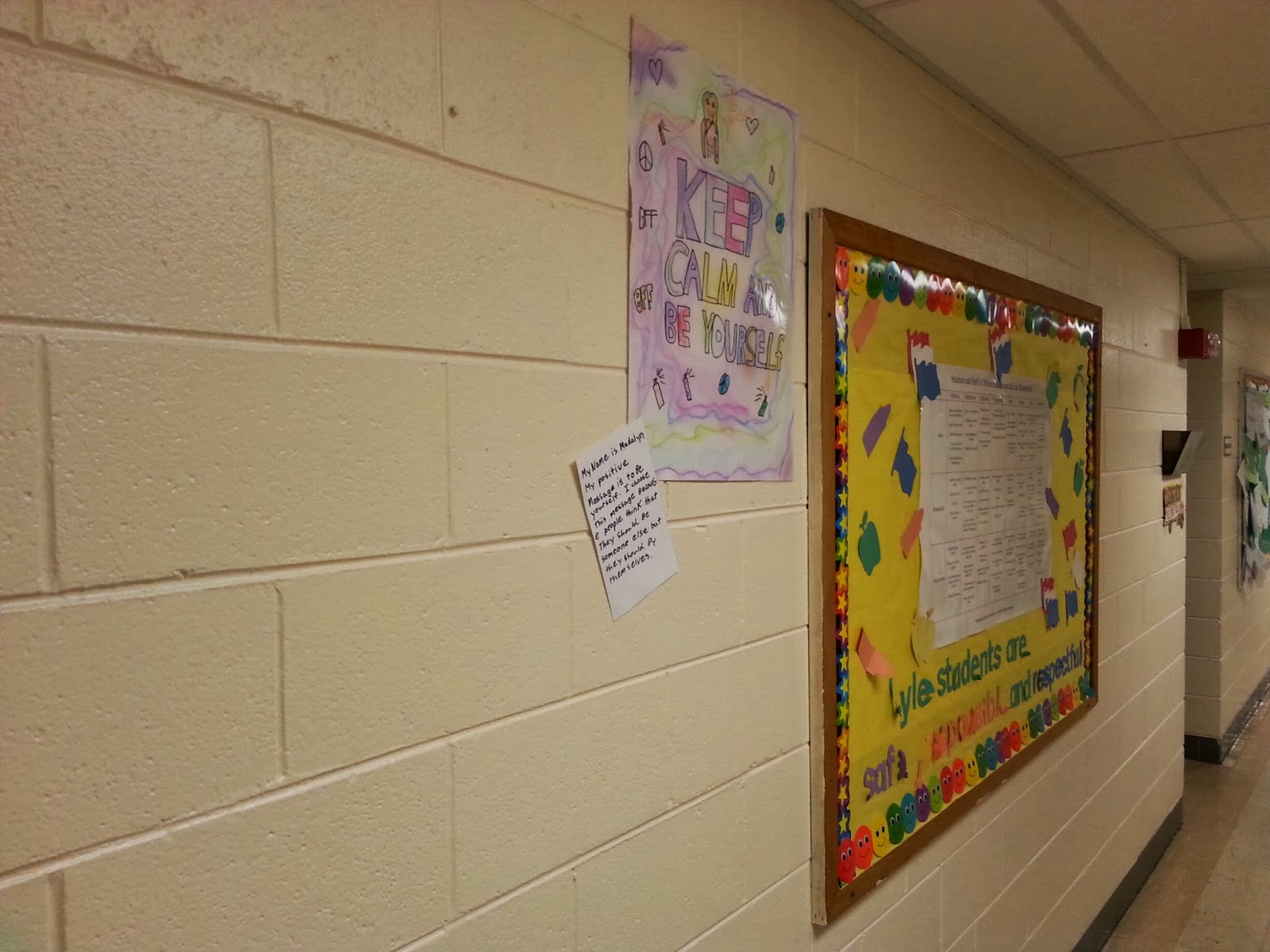
In my class, we discussed how Banksy’s work is a good way to share a positive message. Each student was asked to brainstorm a message to share with the school (for example, stay active, don’t be a bully, be yourself, etc.). The students created artist statements explaining their concept, then created a mural-size drawing that can be placed around the school, similar to Banksy’s style.
One key point I made sure the students understood was that artwork should never be created illegally, meaning not to graffiti a building without the building owner’s permission. Instead, we brainstormed ways to display work that were temporary and could easily be removed if needed.
Materials
-18" x 24" white paper
-Pencils
-Black Markers
-Chalk Pastels
-Scissors
-Wall Adhesive
-If you have access to a hot laminator, use it!
Objectives
The students will understand how art can share messages to the community. Students were to create a drawing that was meant to share a positive message.
The messages could be anti-bullying, helping others, integrity, patience, coming to school prepared, etc…
The drawings were to be placed at random areas in the school to share their message.
Directions
On the first day, I shared a Power Point of Bansky's street art. I wanted to share the news reports I had found, but due to some of Bansky's work being a little to advanced for elementary students, I chose to select the artworks myself.
After viewing the Powerpoint, students were given handout with the following questions (you can design your own by cutting/pasting the questions onto your own sheet):
1. What positive message would you like to share?
2. Why do you feel it's important to share your message?
3. How would you draw your message? Please draw a sketch of your project on the opposite side of this paper.
4. Where would you place your finished work within the school?
After students handed in their "Bansky Brainstorm" sheets, I handed them a large white paper to draw their design. Once drawn, students traced in black marker and colored in with chalk pastel.
Since I only had one 5th grade class at this school, I laminated all their projects to protect their work, them had the students hang there drawings randomly around the school. To save any confusion, student wrote artist statements explain the message they were trying to share.
Looks very similar to having students design school posters? Now you can tie in an artist! Also, this project is open to evolve since the objective is to share a message. Materials could change depending on your situation!
Subscribe to:
Posts (Atom)