Showing posts with label Art Room. Show all posts

Monday, August 17, 2015

Developing Your Art Class Procedures: September's Stepping Stones


It’s the beginning of the school year, and you’re off to a brand new start!  Many educators have been setting-up for years while others are starting in their first year of teaching.  The start of the school year means a clean slate to begin fresh in designing your procedures, which is how you want your art class to run smoothly for the entire school year.

Before you begin, know that not every procedure you develop is going to work.  As much as you think it will be smooth sailing, you need to treat your rules and procedures like a pilot program.  Sometimes, you’re going to need to tweak a rule or two here and there for success.

Here’s a checklist of procedures you should develop in the beginning of the year.  Organizing your routines for students will help make classes run smoother.

1.    Pass Out Procedures
After introducing a project (or even continuing a project), figure out how the materials and projects will be passed out!  If you just say, “Come and get it!” you’ll have a flock of students clamoring to you to see who gets their project first, and there may be hair-pulling!  Consider having your materials ready, calling a table at a time (or desk group), or choosing specific students to pass out each week.

2.    Clean-Up Procedures
Just like passing out, cleaning up can be just as hairy.  I give about 5 minutes at the end of my classes, explain where things go, and count from one to ten to give the students a measured time to clean.  We use the “quick, quiet, clean” routine because I want students to be responsible for their own messes and to not rely on anyone else.  Sometimes, with messy paint or clay projects, I even have specific students help collect larger materials (such as clay clothes or paint trays) to make cleanup easier.

3.    Material Management
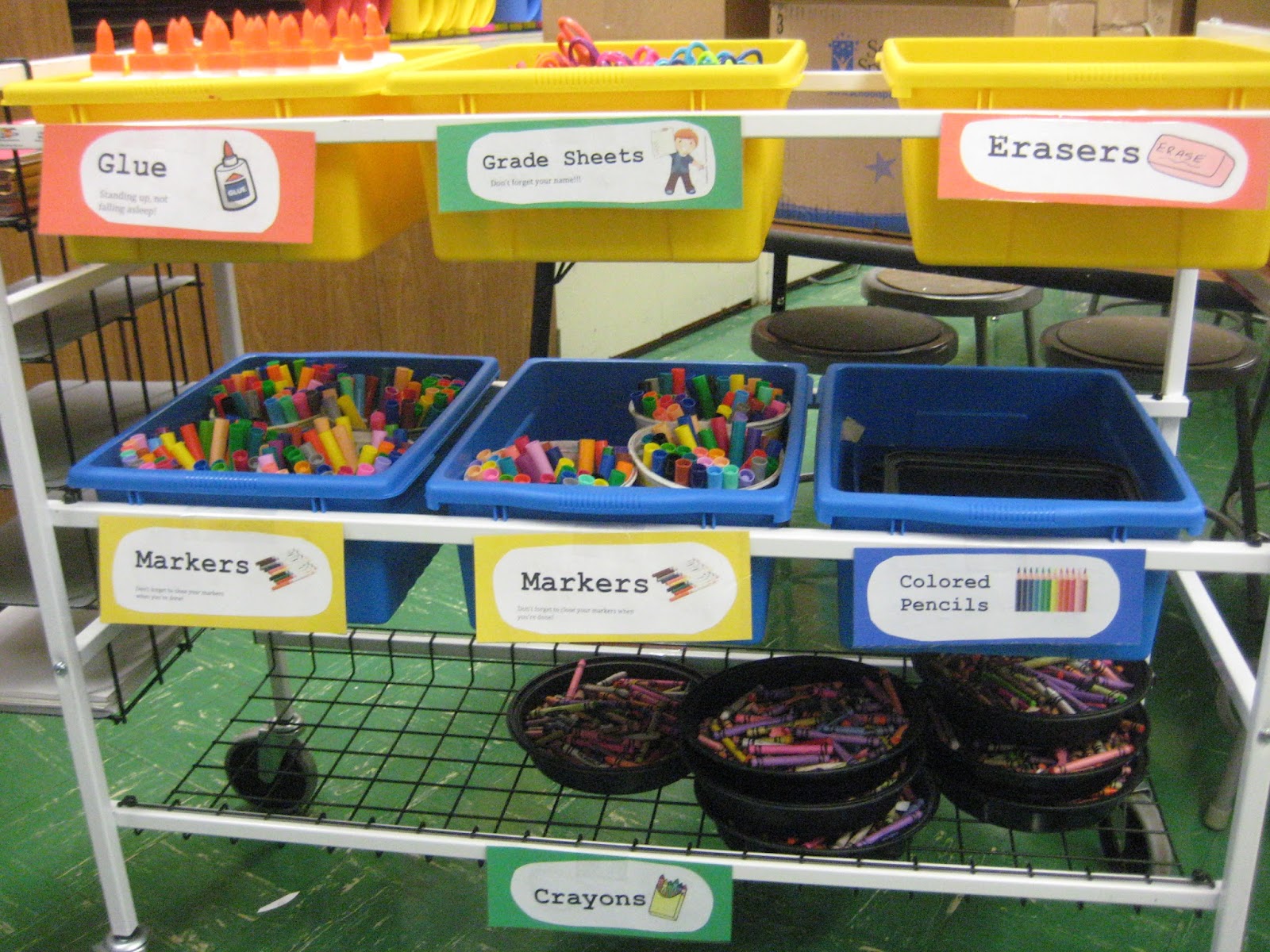
If you’re in a classroom or a cart, it’s always best to have your materials as organized as you can.  In my classroom, I have 6 boxes total each of crayons, markers, and colored pencils for projects.  This saves on arguments in the room!  Check the boxes periodically to make sure materials are even and organized (or you can have a “teacher’s team” helpers do this for you!).  On a cart, consider smaller supply boxes that can be passed out to student groups.  The supply boxes are easy to open and close and saves on spilled materials during clean up. 

4.    The “In Case of Emergency” Kits
Have you ever had those moments when you run out of pencils, erasers, or even water?  I know I have, and it’s a pain to refill when you’re in the middle of managing a class!  In my drawers, I have back-ups of sharpened pencils, erasers, dry-erase markers, and water bottles for those emergencies that pop up randomly.

5.    Volume  Control
In their classrooms, students know what is expected of them with talking and working.  In your class, you make the call.  Some teachers like quiet classes with no talking, but I like collaboration.  Managing noise levels can be very tricky and needs to be manageable for you.  Consider giving a prompt when students start getting too noisy.  My co-worker does the “Mona Lisa” prompt.  When students hear her say “Mona,” they call back “Lisa,” then quiet down so they know the teacher has something to say.  In my class, I assign a “noise manager” table to raise hands when their class gets too loud. 

6.    Where to Find the Water
If you have a sink in your room, you’re golden.  For many others, we must find the water source.  I’m in a classroom without a sink, so to help with water management, I found the closest water closet in the school, plus I have back-up water jugs for those emergencies that pop up.  Plan in time for water fill ups during your schedule so refilling does not interfere with your class procedures.  I highly recommend getting 5 gallon water jugs if you have no close sink resource. 


7.    Art Jobs
Having art jobs in the room or classroom can make your routines run so much smoother!  For example, my class has 6 tables.  Each table has a job that changes each week.  I have pass-out projects, collect projects, noise managers, material counters (check pencils and erasers at the end of each class), floor checkers (for loose materials on the floor), and teacher’s team (for the random extra helpers needed in for some projects).  Each week, the students check to see what their job is and they perform it well!


If you’re in a classrooms or teaching from a cart, find what procedures work best for you, and have fun this school year!

Wednesday, August 14, 2013

Starting Your School Year Off With a Smile! September's Stepping Stones


Arts & Activities issues this image as a sneak peek into their September 2012 issue that will be off the press within a week!

For my first article for the 2013-14 school year, I wanted to focus on how to keep a positive outlook when starting off with the students.  It can be hard for many...some of you have multiple classrooms to set up while others only have a cart and storage room.  No mater what your responsibilities are, you make the best of it!


When you start at the beginning of the school year, remember these key elements to having a successful year:

1.     You have the power to brighten your students’ day with art.  As the art teacher, you are giving your students a chance to speak their thoughts and emotions in ways they cannot say in words.  Having this outlet helps students to be creative thinkers and inventors in their own way.  You are giving them that outlet.

2.     You have the ability to enhance student learning through art.  You bring history, culture, literature, and mathematics into your classroom.  You show them how to problem solve to work through mistakes.  You show the students how manipulating materials can make wonderful creations and how we need art in our everyday lives.

3.     You have the ability to change your situation.  If you struggle with teaching from a cart?  You’re not the only one, and many teachers are sharing their input in art educator groups on the internet.  Are you feeling disconnected from your staff?  Invite them to your room, or start a conversation when you visit their room.  There are ways to make your situation more positive, and even if it takes some work, persistence pays off.   

4.     You are the advocate for the arts in your school, district, local, state, and national community.  Believe it or not, you are the spokesperson for the arts wherever you work.  If you carry a negative attitude about your situation, you will reflect that in your practice.  Show your passion for the arts in each project you teach and all displays you create.  Be proud of your student work and show it off whenever you can.  If you feel burnt out, reach out to others in your field.  There are plenty of art teacher groups on social networks willing to give advice and listen to your concerns, challenges, accomplishments, and honors.


If you are interested in viewing the full article, please click here for the September article of Stepping Stones in Arts & Activities Magazine!!


Sunday, March 17, 2013

Why Pinterest is a Blessing for Traveling Art Teachers


There are tons of blog posts out there that brag about the amazing superpowers of Pinterest.  This post may not be so different, but I felt it's important to share just how much Pinterest has helped me with my lessons while traveling, and even on a cart.

Pinterest helped lighten the load of materials to carry.  Yes, that's right...less materials to pack from school to school.  What made it possible?  The ability to upload print-outs and documents to share.  I have also found other print-outs shared by other pinners that have been quite useful!  Since I've started using Pinterest in my classroom, I spend the morning printing up my handouts for my classes from the pins I have saved onto special boards.  Now all I carry from school to school is my laptop, which is a HUGE load off my back.  I started off with a suitcase every day!


Pinterest helps my organize my lessons.  I have my boards set up in grade levels, along with separate boards for seasonal projects, cultural, cross-curricular, literature based, etc.  I plan it that way to make it easy to find a project idea.  Everyone is different, and I like to call it "organized chaos."


Pinterest helps me to find my websites faster.  When I start a lesson, I create a Powerpoint, or show an interactive website.  Instead of keeping websites in my favorites bar (which has filled up so much I can't find anything anymore),  I organize those sites in boards set up for my projects.  I've even begun setting up a Pinterest account for my school email, so I can organize one project at a time with the ideas I've used.


Pinterest makes it easy to show videos.  Similar to websites, I save videos that I show with certain projects.  When I attempted to save videos in my favorites bar at work, I couldn't find them because they all started with "www.youtube....." (which is impossible to figure out sometimes!)  With the ability to pin videos onto my boards, I can quickly find my pin and open the video for students to view!


Pinterest made it possible to collaborate with other teachers in my district...without taking extra time to meet!  You know how you can create a new board?  Add another pinner to your board by typing in your co-worker's name (if they're on Pinterest too), and you two can share pins together for your cross-curricular lesson.


And as much as everyone's heard this before, the same goes for every art teacher who uses Pinterest: Pinterest has helped expand my curriculum.  Thank to all the amazing art teachers who believe in sharing ideas and not selling them, a network of 21st century skilled art educators borrow ideas on Pinterest and blog posts pinned onto Pinterest, and they even pay it forward by posting their own projects!

Personally, I do not believe in selling lesson plans (unless you go through the efforts of creating your own book), I believe in a network of sharing ideas.  I do not feel I can claim any project ideas as my own original work because I may have been inspired by thousands of other ideas without remembering where I may have received them.  I love to see others take an idea I shared on Pinterest and re-pinning their accomplishments with their students.

I believe in paying it forward.  If you've borrowed lessons from Pinterest, re-post your finished projects.  Share your accomplishments.  Follow other art educators and open new doors for collaboration.

Lastly, I need to pay my respects, because with the help of Pinterest, the viewership of my personal blog has increased.  Every post I make in my blog is pinned so I can share my insight with others, and the word can spread.  Thank you, Pinterest, for helping the art teachers, including those who travel.  You helped lighten my load to carry.


Tuesday, March 5, 2013

Preparing for a Maternity Leave with Traveling


I've hit the halfway point of my pregnancy and my due date is less than a week before we start our next school year.  Lately I have not been able to get my preparations out of my head.  With this being my second pregnancy, I want to be sure I do it differently.

With my first maternity leave, I was pregnant in my first year teaching, which meant I missed a portion of my second year.  I was not sure how to prepare for a leave at that time, so I did not prepare as well as I should have.  I left my curriculum binder for the sub and asked if he/she could set up my room.

I came back after 8 weeks to empty walls, no grades taken, and spent the next two weeks staying late to  organize.  I was not a happy camper.  I realized that if I could have had better plans left behind, things could have been better.  At the time, I was also traveling to three schools, and on a cart at two schools.  I struggled pretty much my entire first year of teaching, so why would I expect someone to handle it within 8 weeks?

I've already taken steps to help prepare for my maternity leave.  Although my leave is in the beginning of the school year, these steps could work for any time of the year with traveling.  I am more than willing to hear any suggestions readers may have that I may have overlooked.  Although I am organized and a little obsessive about my classrooms, I may miss a few things!

1. Prepare your classroom expectations.  Although the sub may want to use their own strategies to manage your classes, the students are familiar with your routines.  Write down your rules for the room to help the sub (in the beginning of the year, I print out my rules to share with the classes to remind them.)  Make copies for all your schools you teach at.  Don't forget the classroom procedures and clean-up details!

2. Write an agenda. Is it the beginning of the school year?  Let the sub know where your displays are at to hang.  Explain where to get the grade books, who to go to for help, where the school art display spaces are, etc...and be sure to do the same for all your schools.  If your leave is at the end of the school year, write directions on where you want your displays placed after being taken down, as well as any wrap up activities need to happen.  In the middle of the school year?  Notify the sub of any events that are happening that they would need to be aware of.

3. Don't miss any extra details.  Notify the sub of seating details, extra duties you attend, meetings, committees, emergency situations, and anything else that would pertain to your duties.  Yes, even traveling teachers have meetings and duties to attend.


4.  Make common materials accessible.  In my second school, I share a room with another art teacher, we communicated on how to use the common materials, such as crayons, colored pencils, markers, and pastels.  We made bins for pencils, scissors, and glue to share as well.  When you're on your leave, notify the sub of where your common materials are placed for projects.  If you do not want the sub to use your clay, just simply tell them in your plans.  Don't be mean, many subs to have experience in the arts and may be able to handle any material you leave behind (I had quite a bit of fun subbing for an end of the year leave before I became a full time teacher!).  Do this for all your schools!

5. Prepare your lesson plans.  In some situations, your sub may have their own lessons that fit into your curriculum.  In other cases, it's better to be prepared.  Depending on the amount of weeks you are away, prepare your lessons for each week.  Notify the sub of where materials are located for your lessons.

6. Be prepared for anything.  Since my leave starts in the beginning of the year, everyone is still trying to get a full time job.  In my previous leave, I didn't get a sub until two weeks into the school year.  I was not happy about that but it can happen.  Be sure to leave plans that any sub can handle for the first few weeks in case your school does not find someone right away.  

From the looks of all the work you have to do, don't be intimidated about having your family! If you take the steps needed to be prepared, you can enjoy your leave with your new bundle of joy and any future bundles you may have!


Sunday, February 17, 2013

The Love/Hate Relationship Called Art Materials


I love art supplies.  I love opening new packages, replacing empty material bins, and pulling the materials out for the first time with a new project.

I also hate art supplies. I hate writing up the orders, squinting at the order codes, typing them into the small order forms, squeezing in as much as I can into my sometimes tight budget, and realizing I forgot and item after the orders been sent in.

Working with art materials is my biggest love/hate relationship with my job.  And it's on my mind because I have to work on next year's supply budget already!

If you're an art teacher like me, you have orders coming out of more than 5 different catalogs...clay comes out of one, Triarco, United, Nasco, Sax,and Dick Blick fight for the best prices (and there's even more catalogs to order from than I listed!).  Then you have your basic teaching supplies: tape, pencils, staples, etc...

Ahhhh!!!! It's so much!

And you do it all to get the most for your money.

Here are a few tips for when you plan your supply budgets.

1. Use excel to create your order forms.  Make a separate form for each catalog you order from.  You can save it for the next year, which makes it a little easier to repeat items you order every year without re-typing all the product codes and descriptions.  All I do it update the page numbers and product prices.  I also print the order and tape it on top of my school's requested budget forms.

2. Spend at least one year in depth with researching the best prices out of all the art catalogs you can.  This will also make it easier to complete #1 in the next few years.

3. Find the free shipping.  That will save you at least $50-$60, which can go right back in for more supplies.

4.  If you can do it, order bulk in just a few items every year.  I did this with markers and oil pastels, and with prices that go up every year, I have at least 3 years backup supply.  Change around the items each year, and you're golden.

5. If you are short on your budget, create an account with Art Room Aid or Donorschoose.org.  If you start both projects a year ahead of time, you will have extremely generous donors help you out with your budget woes.  I would recommend setting up projects with materials that are special (crayola model magic, acrylic paint, printmaking, etc...) so you can use your actual budget for your most needed materials.

6.  Know your space and storage.  This is one piece of advice I need to follow myself!  I am overbooked in my main classroom because I teach the most there.  I need supplies for 23 classes, averaging 25 students per class, plus I host an after school art program.  My second school used to be on a cart.  I have everything on boxes and bins, and even forgot what items I had because they were stored away so deep.

7. Label your stuff.  Have you ever thought you were out of supplies, then ordered them, then found that supply you thought you were out of, which left you with double the supply?  Yeah, that happens to me a lot.  Labeling my cabinets helped alleviate that problem.

8. Leave some money for the middle of the year.  I always have to order more supplies mid-year, either because I don't have enough and ran out, or I need fresh clay.  It sucks to have to write out another order, but it helps.  My principals automatically hold back a small amount every year, and around December, I place a second, much smaller order.

In the beginning of the next school year, you get your biggest reward from all that hard work: boxes of new art supplies!


You hate to create the lists, and budget, and scrimp/save, and label, and re-type...but the end result feels like Christmas.

Tuesday, January 15, 2013

What do you do with all your broken art supplies?

One day, I finally got tired of finding dried out un-capped markers, broken pencils, and unwashed paint brushes all over the place.  When I had my cart, I didn't have this much of an issue!  I decided to create an "art material gravesite" for all the neglected materials in my room. 


After creating the box, I started filling up fast.  Within a week, the box was half-way full.  I then started to show the students the broken materials collected and explained how much material is wasted when items are not cleaned properly.  Needless to say, after that week of sharing the box with students, they have been taking better care of the materials!  I still get those few students that don't wash things or cap them properly, but more students are checking materials properly before putting them away.  So overall, the gravesite has been a positive addition to our room and broken materials have been fewer and fewer each day!

Thursday, January 10, 2013

Continuing to Balance the Scales: More Pros to Your Cons with Traveling and Teaching Art

Before I get into my extended list, I wanted to apologize for not posting since before Christmas.  I had found out that I am expecting and even looking at a computer screen was making me nauseated.  Even the smell of paint in the classroom!

When I created my first list of pros and cons, my intent was to share that every negative thought you may have actually has a positive outlook in any situation.  At times, it's good to vent, but too much venting can turn off your co-workers and colleagues.  This year, I started coming across more irritations that I needed to face, and decide on how the positive outcome should be.

I wanted to start by showing my original list of cons with the pros.  The list was recently published in the Stepping Stones section of Arts & Activities magazine.


Negative: I’m on a cart, stuck in a closet, with no sense of space. 
Positive:  Yes, you may not have a room, and your storage closet houses your desk, but look at it this way!  A room takes much longer to set-up and take-down, or even clean up at the end of the day.


Negative:  I don’t feel like I belong with the other teachers.  They seem to cling together when talking about standard tests and classroom activities.
Positive:  It takes time to build lasting friendships with co-workers and other staff, and sometimes it may not happen the way you want!  Your job is to convince your fellow co-workers that you are worthwhile.  Talk about their students’ personalities and how it reflects in their artwork.  I've been working with my staff for 6 years and over friendships continue to grow!


Negative: I keep tripping over my cart, and items keep falling off the cart! Arg!!!!
Positive: In the morning, try and leave some of the items you’re using with certain classes within their rooms…or make a trip back to your storage room (if you have allotted travelling time between classes).  That will save on the items falling off or breaking, but I can’t help you with the cart tripping…that’s just a convenient annoyance we must deal with!


Negative: The materials are too difficult to disperse in the classrooms!  The teacher just leaves no space for me!!!
Positive:  As said before:  Communication is key.  Let the homeroom teacher know you need the space, or you’ll place your items on top of their stuff. 


Negative:  No Storage for projects!!!
Positive:  True…but have you talked with the homeroom teachers about allowing some small space in their rooms to be used?  For example, the tops of closets/cabinets, or even by the window sill?  If not, talk with the administrator and ask for space in the school for certain projects that can be used temporarily.


Negative: I feel like I’m invading their room.
Positive:  True, but think of it from the homeroom teacher’s perspective…they feel like they’re invading your class as well.  This is when you work as a team.


Negative: I’m struggling with communication, I feel like I’m the last to know everything.
Positive:  Travelling from school to school?  It happens, but you can fix the important items, such as meeting dates and other important information.  Communicate with the administrators about keeping you in mind for important facts, and don’t be afraid to let them know when they’ve forgotten something.


Negative:  My car is an art storage closet!
Positive:  That can be fixed.   When ordering supplies from year to year, build up a collection of materials that can fit in your storage space, so you no longer have to carry it from school to school.


Negative:  It’s such a challenge to communicate with parents.
Positive:  I can’t lie, it is, but that doesn’t mean you stop calling them when you need to make that call.  Just find the time on another date (unless it’s urgent) and let the parent know your situation.


Negative: Disciplinary actions are hard to keep track!
Positive:  That’s another communication issue.  Discuss options with the homeroom teacher, but more importantly…call the parent!


Negative:  I always forget something at another school!!!!!
Positive:  I can’t help you there!  I do it too!  Just make sure you get to your school with enough time to pick the item up if you need to.

Over time, I did not see many of these negatives as much as an issue because I always believed there was a light at the end of the tunnel.  But, not everything is always perfect.  My next list is the challenges I've been coming across lately, and advice I want to follow to have a positive outcome.


Negative: I have a new principal and everything is messing up.  I had a schedule down, but it's like re-learning a routine again.
Positive: Don't look at this as a negative, but as a learning experience on both ends.  If you have events or meetings coming up annually, be sure to communicate this with your new administrator.  Be flexible. and allow the learning curve for both of you.


Negative: I share a space with another teacher, and every time I walk into the school, I find a note telling me I left something out, unlocked, or things are missing.
Positive: Your co-worker may be leaving you notes, but don't look at it as wanted to get her back by leaving notes for him/her. We all make mistakes.  Work out a checklist to follow at the end of the days you leave so you don't repeat mistakes.  If he/she is still having issues, address your concern about their outlook on the situation.


Negative: I fundraised for a display space, which finally came in!!!  But it was set up when I wasn't there, and they made the decision without me to move it to the back of the school.
Positive: At least you have a display space.  Think about it that way.  Display...Space.


Negative: I feel so far behind with technology.  I'm so limited on the cart, and I can't seem to check out the laptops when I need them. 
Positive: The technology standards are there for a reason, but it doesn't mean you shouldn't be left out.  Find out what's available in your school, and use what you can to educate your students.  Laptops checkout, projector carts, don't give up!  It may be an extra cart, but it's worth the amazement in students' eyes as you show them that virtual gallery on a museum website!


Negative: Our district says apple technology is not compatible with our server.  With all the recent presentations and amazing technology advances with iPads, I feel far behind and lower than other art teachers who do have this available for their students.
Positive: Technology standards do not say you need an iPad to educate your students.  Laptops are just as cool since you can share art-based websites and virtual galleries!  Look past the jealousy factor and work with what you have.  If you feel iPads are that important, try looking into grants available to bring iPads into your classroom.  There are apps available that do not require internet use, so server issues would not be a problem if you acquire iPads for your room.


If you probably couldn't tell, these were my recent issues.  I dislike having to complain about anything, and I always want to try and overcome any challenge I can.  Even if they are my recent issues, some of you may be dealing with similar situations in your own buildings.  Just remember not to give up and look for that light at the end of the tunnel.  It worked for me, and I love my schools!

Wednesday, November 7, 2012

Sharing Spaces

I've been pondering how to write this particular piece because I'm having a tricky situation this year.  Allow me to share the story:

I share an art room with another art teacher.


There's the brunt of the story.  No juicy details, no cat fights or name-calling...just sharing.

I do not wish to make anyone appear as a complainer or share frustrations.  As I've been pondering, I felt the need to share ways to create an inspiring art space that could be shared between two artists, or two dominant type A personalities.

I would like to list some challenges I have come across and share with you what works best in my situation.

Challenge #1: Veteran Teacher vs. Novice.  In my case, I am the novice.  I've been in the district for 6 years, my co-worker for over 20 years.  Knowledge and wisdom are wonderful tools, as well as mentorship possibilities.  Respect the advice your co-worker gives.  He or she may have some good stories to share.

Challenge #2: Materials.  I learned from day one that materials that are ordered are ordered separately.  We have saved on countless frustrations because we knew to keep our materials separate.  We share very few materials, such as the drying rack, paint cups, and the cutting board, but almost everything else is our own.  When we were both on carts, we had our own storage space separated, and it worked wonderfully.  Now that we have a shared room, we have our own shelves and space in the room for our materials.  This way, when one teacher walks out and the next teacher walks in, our materials are still there...especially the consumables.  With a shared room now, we combined crayons, markers, and colored pencils, and drawing books since they're the most used items for projects.  Everything else...still separate.  We like it that way.


(My old cart!  It's now turned into the resource cart: art books, coloring sheets, crayons, colored pencils, games)

Challenge #3: Communication. When it came time to set up the room, I was extremely passive.  I thought, "Hey, she's been wanting a room for the past few years, she's got it, I'll let her figure the floor plan!"   Then, when it was arranged, I found it incredibly difficult to navigate.  Instead of holding it in, I felt the right thing to do was to talk with my co-worker about the set-up and what would work best in both of our situations.  We came to an agreement, and now we're good.  If you've ever seen the end of the movie "Legally Blonde 2," you'll know what I'm talking about.  Speak up and share your voice, but don't be a meanie about it.


(With being on a cart for years, we are slowly building up out visuals for the room.  It takes time!)

Challenge #4: Display Space.  Throughout the school, everyone battles for display space.  My co-worker and I have specific spaces, but we have had conflicts with the usage of that space.  This year, we decided to alternate displays each month.  This gives us a chance to showcase student work from both art teachers.  My challenge is that I wished I could show more  of my student's work.  Who doesn't want to show off their awesome, amazing masterpieces?  Still, as role models for our students, we show how sharing is positive thing to do!


(Look familiar?  Yes, it's a Keith Haring inspired project I found on Pinterest.  Thank you to the original creator, my 5th graders were proud!)


(My co-worker's display space)

Challenge #5: Dealing With the Little Mistakes.  It's been two months into the school year, and we have had a few mistakes along the way.  The key is forgiveness.  Everyone makes mistakes, and holding grudges is never a good thing to your stress and your health.  Oops, one of us forgot to lock the paper cabinet.  It happens.  There can be a list of little mistakes that happen every day, the key is to communicate, be respectful, and try not to make the same mistake twice.


(Always make sure you double check your space before passing it over to the next person!)

In a way, I feel that writing this has helped me to understand that any frustrations I may have had, it's nothing compared to the big picture:  We are there for the kids.  We love our jobs, and we love art.